Benchmark Product Selection: Active Botanical Extracts & Bioactives
Laboratory-assayed reference ingredients available for immediate dispatch, pilot formulation, and industrial contract manufacturing.
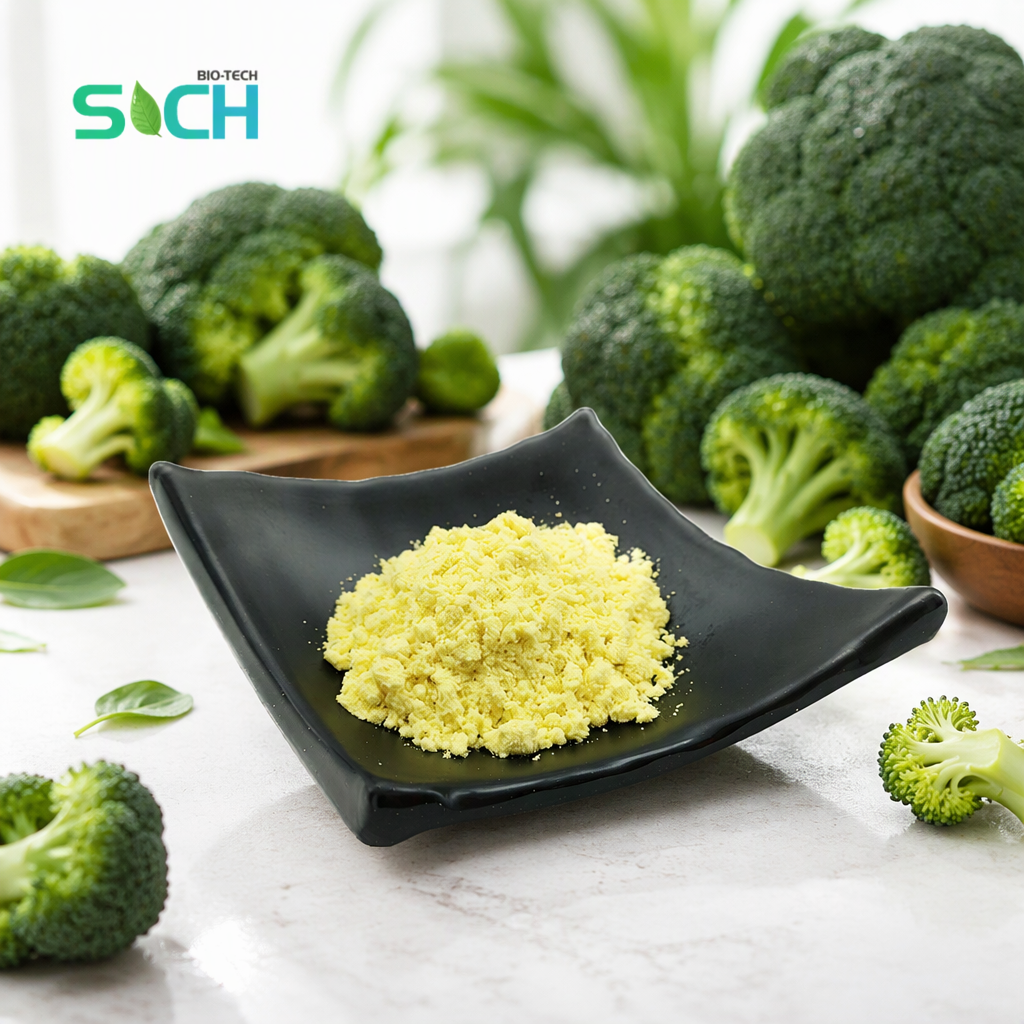
Food Grade Sulforaphane 1% CAS 4478-93-7 Broccoli Seed Extract Powder
Get a Quote
1. The Global Landscape of Natural Plant Powder Manufacturing & Export
The global botanical powder and plant extract market has reached an unprecedented inflection point. Driven by clean-label consumer mandates, regulatory harmonization under the United States Pharmacopeia (USP), European Pharmacopoeia (Ph. Eur.), and China National Standards (GB), international procurement teams are eliminating intermediary brokerage layers. Today, procurement directors from functional food, nutraceutical, pharmaceutical, and high-performance cosmeceutical sectors demand direct-from-factory validation, full raw material traceability, chromatographic batch fingerprinting, and guaranteed absence of ethylene oxide (EtO), polycyclic aromatic hydrocarbons (PAH4), and heavy metal complexes.
In this rigorous commercial landscape, selecting a qualified export partner among the top natural plant powder factories and exporters requires understanding the divergence between low-tier aggregators and integrated phytopharmaceutical manufacturers. Gavra Bio-Tech Co.,Ltd., situated in Henan, China, stands as an exemplar of the integrated model. By linking 500 acres of experimental agricultural cultivation directly to an 8,000 square meter cGMP-standard extraction infrastructure, the facility eliminates supply elasticity risks and active compound degradation across the entire supply line.
Secondary plant metabolites—including glucosinolates (sulforaphanes), bioflavonoids, and delicate phycobiliproteins—suffer significant thermal and oxidative breakdown if processing parameters are not tightly controlled. True industrial leaders leverage low-temperature counter-current extraction coupled with vacuum flash evaporation to retain peak therapeutic density.
Qualitative Differentiation Among Top Exporters
Industrial suppliers are evaluated across multi-factorial benchmarks: the capability to execute extraction, fractional distillation, rectification, preparative chromatography, and aseptic spray drying within a unified closed-loop cycle. Low-tier exporters often struggle with solvent residue control (such as residual ethanol or ethyl acetate) and lack batch-to-batch standardized assays. Conversely, Tier-1 manufacturing facilities maintain independent Analytical & Testing Centers directly integrated into the production control loop, ensuring that certificates of analysis (COA) reflect empirical High-Performance Liquid Chromatography (HPLC) and Liquid Chromatography-Mass Spectrometry (LC-MS) assays.
2. Analytical Rigor: The Gold Standard in Plant Powder Testing
Authenticity and compositional fidelity represent the cornerstone of E-E-A-T compliance in the botanical active industry. Adulteration, intentional economic dilution, and accidental cross-contamination plague low-cost supply chains. For example, in products such as Poria Cocos Polysaccharides, Broccoli Seed Sulforaphane, and Ectoine Powder, simple spectrophotometric UV-Vis testing can easily yield false positives when non-specific interferents are present.
To ensure unassailable data integrity, top-tier production centers employ a tripartite testing hierarchy:
- Waters LC-MS (Liquid Chromatography-Mass Spectrometry): Deployed for definitive molecular mass confirmation, trace degradation pathway tracking, and secondary metabolite profiling down to parts-per-billion (ppb) thresholds.
- Agilent 8453 UV-Vis Spectrophotometer: Calibrated for rapid routine multi-wavelength quantitative screening of recognized target chromophores under strict validation methods.
- Swiss CAMAG High-Performance Thin-Layer Chromatography (HPTLC): Serving as the gold-standard botanical fingerprinting system, enabling unambiguous visual and instrumental identification of authentic species against botanical reference standards.
Technical Benchmark: Primary Manufacturer vs. Commodity Trader
Critical metrics differentiating certified cGMP botanical extraction plants from non-manufacturing brokers.
| Evaluation Parameter | Primary Factory (e.g., Gavra Bio-Tech) | Conventional Trading Broker | Impact on End-Product Formulation |
|---|---|---|---|
| Raw Material Origin | 500-Acre Monitored Fields, Full Traceability | Open Wholesale Spot Market | Prevents pesticide drift, heavy metal spikes, and adulteration. |
| In-House Analytical Arsenal | Waters LC-MS, Swiss HPTLC, Agilent UV-Vis | Outsourced or Re-issued Paper COA | Ensures assay veracity; zero regulatory rejection at customs. |
| Workshop Certification | 8,000 m² cGMP-Grade Clean Workshop | Non-certified Warehouses | Eliminates microbial cross-contamination and aerobic spore formers. |
| Custom Granulation / Mesh | 80 to 200 Mesh, Micronized, Granulated | Fixed Standard Stock Only | Optimizes direct compression in tablets and solubility in RTD beverages. |
| Supply Stability & Logistics | FedEx/DHL SVIP Priority, Dispatch in 3-5 Days | Variable 2-4 Weeks Sourcing Lag | Guarantees JIT inventory reliability, reducing factory holding costs. |
Future Procurement Trends in the Natural Plant Powder Sector
Key technological, regulatory, and logistics shifts reshaping international supply agreements through 2026–2030.
1. Transition to DNA Barcoding & HPTLC Fingerprinting
Global health authorities (US FDA, EFSA, NMPA) are shifting inspections from basic assay percentages to full genetic and botanical spectrum fingerprinting. Procurement protocols increasingly require suppliers to provide HPTLC digital plates verifying the natural chemotaxonomic origin of every batch.
- Species verification at the molecular level
- Elimination of adulterant fillers and synthetic boosters
- Full compliance with USP botanical monographs
2. Green Extraction & Zero-Residue Technologies
The adoption of Subcritical Water Extraction (SWE), Supercritical CO2 extraction, and membrane-based physical separation has surpassed older organic solvent extraction methods. Procurement contracts now enforce strict limits on residual solvents, targeting zero detection for Class 1 and Class 2 solvents.
- Pure solvent-free aqueous and supercritical outputs
- Preservation of thermosensitive bioactives
- Low-carbon footprint, ESG-aligned manufacturing
3. Direct B2B Micro-Lots & JIT Agility
Large-scale pharmaceutical and supplement brands are re-architecting supply chains to bypass regional wholesalers. Buyers are leveraging direct-from-factory JIT models with flexible MOQs starting at 1 kg for pilot testing and scaling to multi-ton containers seamlessly.
- SVIP freight tie-ups guaranteeing 3–5 day international air dispatch
- Real-time batch reservations via warehouse digital platforms
- Immediate sample testing directly from current production runs
3. Enterprise Manufacturing Strengths: The Gavra Bio-Tech Engineering Framework
Established as an engineering-driven manufacturer, Gavra Bio-Tech Co.,Ltd. maintains an integrated facility in Henan, China, designed specifically to eliminate traditional production bottlenecks in the plant powder and botanical extract sector. With an enterprise footprint spanning over 8,000 square meters of cGMP-compliant cleanrooms, the plant is outfitted with more than 150 dedicated pieces of processing machinery, organized across three distinct operational units:
Continuous Countercurrent Extraction & Low-Temperature Concentration
Traditional batch extraction often subjects plant raw material to excessive heat, resulting in polysaccharide degradation and phenolic caramelization. Gavra Bio-Tech's production line incorporates continuous counter-current solid-liquid extraction with multi-effect falling film evaporators. Operating under high vacuum at temperatures below 50°C, the facility preserves the tertiary molecular structures of delicate extracts like Poria Cocos polysaccharides and thermolabile sulforaphanes.
Industrial Chromatography, Rectification & Molecular Distillation
For compounds requiring extreme chromatographic purity—such as Tranexamic Acid (≥99%), Ectoine (≥99% HPLC), and L-Carnitine Tartrate—our purification suites integrate macroporous resin adsorption columns and precision fractional crystallization tanks. This guarantees the separation of structurally similar isomers, heavy metals, and residual inorganic salts.
Aseptic Spray Drying & Lyophilization (Freeze-Drying)
Finished powders are processed in a Class 100,000 clean air environment using advanced centrifugal spray towers equipped with HEPA filtration, dehumidified collection chambers, and clean-in-place (CIP) spray heads. For highly delicate colorants and biologicals—such as Spirulina Phycocyanin (E3 to E40)—the facility utilizes industrial-scale vacuum lyophilization, yielding instantaneous cold-water dispersion, uniform bulk density, and exceptional reconstitution performance.
Beyond raw powder supply, Gavra Bio-Tech operates automated solid dosage manufacturing suites capable of formulating, blending, and converting high-purity botanical powders into turnkey finished products: custom soft candy (pectin/gelatin gummies), two-piece hard vegetable capsules, and enteric-coated direct-compression tablets.
Frequently Asked Questions: Global Industrial Procurement
Authoritative technical, commercial, and regulatory guidance for international quality assurance directors and supply managers.
How does Gavra Bio-Tech guarantee batch-to-batch chemical uniformity across seasonal harvests?
What analytical procedures are employed to prevent the entry of adulterated or synthetic active substances?
What are the exact minimum order quantities (MOQs) across diverse product groups?
1. Cosmetic Bioactive Peptides & Advanced Actives: MOQs start from 1 g to 10 g (e.g., GHK-Cu, SNAP-8).
2. Standardized Plant Extracts & Cosmetic Raw Materials: Standard MOQ is 1 kg (e.g., Poria Cocos, Ectoine 99%, Tranexamic Acid).
3. Bulk Functional Food Powders & Sweeteners: Supplied starting at 25 kg fiber drums with double-sealed polyethylene food-grade liners (e.g., Sodium Cyclamate, Watermelon powder).
Can prospective B2B clients secure qualified pilot testing samples prior to commercial commitment?
What microbiological and contaminant thresholds are maintained across food and cosmetic grade lines?
What are standard fulfillment lead times and global freight logistics protocols?
Which commercial Incoterms and international payment mechanisms are accommodated?
Does the factory accommodate tailored physical specifications such as bulk density, particle size, or granulation?
How does Gavra Bio-Tech manage heat-sensitive biological colorants such as Phycocyanin?
What are the structural procedures for executing full OEM/ODM contract manufacturing?
Direct Factory Quotation & Technical Dossier Access
Connect immediately with our industrial engineering team in Henan, China. Request full analytical dossiers (LC-MS / HPLC / HPTLC), custom mesh-size quotations, and priority sample dispatch within 2 hours.